Friday, January 31, 2020

3 | The Two Tasks by Charles Malik

Does this 46-page essay that I read over a period of two nap-times count as a book if it is bound by itself? This mother of a 6-month-old says, YES! Judge me if you want to.

Last year, Andrew and I read A World Made New: Eleanor Roosevelt and the Universal Declaration of Human Rights by Mary Ann Glendon. With all of the ethical issues our country is facing today, I wanted to learn more about this declaration, as it is the starting point for many nations' moral policy. While reading this excellent work (Would read parts again. Would absolutely (and have) recommend to friends. 8/10.), I discovered a previously unknown-to-me figure, Charles Malik

Malik was a Lebanese diplomat, philosopher, and devout Christian. He was concerned with the ways our ideas and words shape what happens in the world. My wonderful husband gave me a couple of his essays, The Two Tasks included, for Christmas, so I have been able to get to know Malik even more!

THE TWO TASKS | CHARLES MALIK


My edition is complete with a immensely helpful preface by Duane Liftin, President of Wheaton College, and a foreword by Billy Graham, whose reputation precedes him. This essay is a transcription of a speech Malik gave in September 1980 for the dedication of the Billy Graham center at Wheaton College.

In his speech, Malik details the two tasks that face every thoughtful Christian today: First, evangelicals must affirm and make use of the fullness of Christian history. By which he means we must not cast off the wisdom of the past simply because it belongs to another tradition. Rather, in the spirit of unity, evangelicals must read and appropriate the wealth of knowledge found in the Catholic and Orthodox tradition. Second, evangelicals must seek academic excellence--not merely in theological understanding, but in all areas of academia. Malik is discouraged at the absence of Christian scholars leading fields such as engineering or biology. Surrendering academia to a humanist worldview, in Malik's view is destructive to the minds and hearts of today and tomorrow.

Malik views these two tasks of the mind as part of the evangelistic "Great Commission" of Jesus in Acts 28. Loving God with our mind, as well as our heart and strength, is vital to the spread of Jesus' Good News! Duane Liftin helpfully summarizes Malik's intent: "Ideas have consequences, and the central claim of the Christian life--Jesus Christ is Lord!--bears the largest consequences of all. These consequences begin with the urgency of global evangelism, and as Ambassador Malik reminds us, they also include the need for Christians to be about the business of thinking deeply for Christ's sake."

I loved reading this text, I only wish it had been longer so that more time could be spent with this faithful thinker. Conclusion:
May read parts again. Would 100% recommend to other Christians. 7/10.

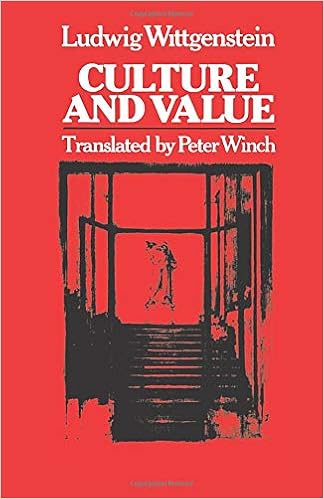
2 | Culture and Value by Ludwig Wittgenstein

My second book this year read more like a notebook than anything else, and, in a sense, it was. Peter Winch, the translator, offered a superb introduction, letting the reader know that the book was a compilation of notes ranging over a period of several years in Wittgenstein's works.

I have been wanting to read this book since my second semester of graduate school: One of my professors quoted it, saying, "This is how philosophers should salute each other: Take your time!" Wittgenstein's quote struck me as profound that day, and I have wanted to read it in context ever since.

CULTURE AND VALUE | LUDWIG WITTGENSTEIN


It is hard to offer a summary of this book; it covers a broad range of topics, and there is no clear connection (as far as I can tell) between the different ideas. Some topics that stand out in my mind are Wittgenstein's fascination with the compositions of Schubert and music in general, thoughts on teaching and thinking, and the complicated nature of religion---particularly, Christianity.

One quote that stood out to me as I read was toward the middle of the work:
“I believe one of the things Christianity says is that sound doctrines are all useless. That you have to change your life. (Or the direction of your life.) It says that wisdom is all cold; and that you can no more use it for setting your life straight than you can forge iron when it is cold. The point is that a sound doctrine need not take hold of you; you can follow as you would a doctor’s prescription. — But here you need something to love you and turn you in a new direction. ... Wisdom is passionless. But faith by contrast is what Kierkegaard calls a passion.”

It is interesting to take these quotes out of context. What was Wittgenstein experiencing as he wrote? Having not studied Wittgenstein very intensively in the past, all I can do is speculate and hope for a day when I have time to find answers to this question. Helpfully, Peter Winch orders the comments chronologically. One interesting thing I noticed as I progressed through the book was that the farther I read, the more references to music and religion I uncovered. I wonder how this is significant considering the life of Wittgenstein. Alas, questions for another day.

On the whole, what I feel I most gained on my first reading of this book is insight into the mind of a great thinker. His mind bounces around from topic to topic, too. He is stumped by impossible questions, too. These are comforting realizations.

Conclusion:
Need to read again. Would recommend to certain friends. 7/10.

1 | Letters to the Church by Francis Chan

2019 was a full year: I completed graduate school, remodeled a bathroom, became an adjunct instructor, and had a baby! I am hoping that 2020 will bring more rest and time for leisure, in the classical sense of the word. Since my son was born, I have found myself with less time for reading as well as less mental acuity to take in the same level of content I had been consuming prior to giving birth--sleepless nights really take it out of you!

To help break through the sleepy haze I have found myself in, I set a goal to read one book each week in 2020: 52 books over 52 weeks. As a way to keep track of my goal and to stimulate thoughtful consumption of the literature I take in, I am going (hopefully) to write about each book I read. I aim to include a synopsis and critique of all 52 books I read this year.

I know what you're saying, whoever you are: Jenn, it is January 31st! You are so behind on your reading! Well, the good news is I have already completed 5 books this year! So, for the next few days, I am going to try and blast out 5 blogs to get caught up on my critiques. My first 5 posts will probably be shorter for that reason, and my reading responses will hopefully get longer when I get caught up.

One thing that will be fun to me and probably uninteresting to anyone else who may accidentally stumble across this blog is that I do not plan to stick to one genre of books. I want to read some philosophy (my area of study), theology, fiction, history...you get the idea!

Now that I have established my plan, let's get to our first book!

LETTERS TO THE CHURCH | FRANCIS CHAN

Image result for letters to the church chan


Have you read Francis Chan before? When I was a junior or senior in high school, I read Crazy Love. The thing that stood out to me about my first exposure to Chan was how well he set up his call to action. I really wanted to make changes in my life when I finished reading CL. When I picked up Letters to the Church--actually my husband picked it up on his lunch break one day to read with me--I expected it to have a similar effect.

Chan wrote about his experience leaving Cornerstone, living overseas and experiencing church in Asia, and returning home with a call to begin a church planting network. The question that rose to the surface as he discussed all of this was "What does the Bible say Church should be, and why do our churches look so different from this?"

Among his many answers, the one that was the most profound in my mind follows: The Bible teaches that unbelievers will be drawn in by the love Christians have for one another. Therefore, our churches ought to be marked by the love of Christ. How does the love we see in churches stand out from the love we see in other parts of society? Consider the following acts of love: providing a meal for a friend who just had a baby, calling a friend you know is going through a hard time, telling your friend when they have broccoli stuck in between their teeth... Okay--the last one is a joke, but you get the idea. These are acts of love that are experienced both inside and outside of Church. These acts of love, while genuine and beneficial, must not be examples of the kind of love we are being called to, as believers; instead, we are being called to show a much more sacrificial love--the kind of love that is willing to die completely to self.

I left this book feeling challenged to give more of myself in love to others. I left this book feeling inspired to find a deeper understanding of Christ's sacrifice for me, for us. I left this book with the desire to share the same love that has been shown to me.

Overall, I give this book high praise; however, I do have to critiques. First, this book was obviously written by a speaker. From small grammatical errors to the overuse of exclamation points and italics, I was thankful to be reading this book aloud with my husband, instead of just reading it to myself. Second, I felt like most of the concepts explored and advice offered, while profound and biblical, was primarily abstract. Although I left inspired toward change, I felt stumped about what those particular changes ought to be. This could have been deliberate on the part of Chan; perhaps he desires for his readers to seek God themselves to uncover where Christ's love can shine more brightly in their particularities.

Conclusion:
Would read again. Would (and already have) recommend to a friend. 8/10.