I have been wanting to read this book since my second semester of graduate school: One of my professors quoted it, saying, "This is how philosophers should salute each other: Take your time!" Wittgenstein's quote struck me as profound that day, and I have wanted to read it in context ever since.
CULTURE AND VALUE | LUDWIG WITTGENSTEIN
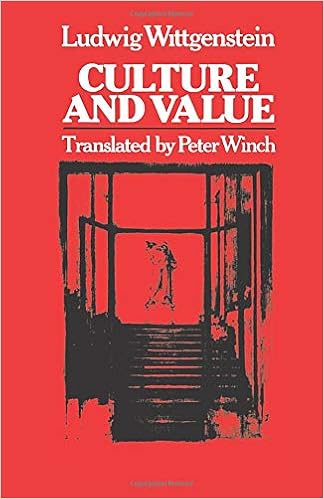
It is hard to offer a summary of this book; it covers a broad range of topics, and there is no clear connection (as far as I can tell) between the different ideas. Some topics that stand out in my mind are Wittgenstein's fascination with the compositions of Schubert and music in general, thoughts on teaching and thinking, and the complicated nature of religion---particularly, Christianity.
One quote that stood out to me as I read was toward the middle of the work:
“I believe one of the things Christianity says is that sound doctrines are all useless. That you have to change your life. (Or the direction of your life.) It says that wisdom is all cold; and that you can no more use it for setting your life straight than you can forge iron when it is cold. The point is that a sound doctrine need not take hold of you; you can follow as you would a doctor’s prescription. — But here you need something to love you and turn you in a new direction. ... Wisdom is passionless. But faith by contrast is what Kierkegaard calls a passion.”
It is interesting to take these quotes out of context. What was Wittgenstein experiencing as he wrote? Having not studied Wittgenstein very intensively in the past, all I can do is speculate and hope for a day when I have time to find answers to this question. Helpfully, Peter Winch orders the comments chronologically. One interesting thing I noticed as I progressed through the book was that the farther I read, the more references to music and religion I uncovered. I wonder how this is significant considering the life of Wittgenstein. Alas, questions for another day.
On the whole, what I feel I most gained on my first reading of this book is insight into the mind of a great thinker. His mind bounces around from topic to topic, too. He is stumped by impossible questions, too. These are comforting realizations.
Conclusion:
Need to read again. Would recommend to certain friends. 7/10.

No comments:
Post a Comment